

In just two semesters, the student team of the "Nuevo35" research vehicle has developed three new components that make the prototype even more sustainable and energy-efficient.
This research project combines practical teaching with sustainable mobility: since 2020, the "Nuevo35" has been continuously developed further and brought closer to perfection by changing teams of students at Fachhochschule Dortmund.
The electrically powered vehicle should achieve an extremely low CO₂ footprint of 35 grams per kilometer driven - and that already includes production, electricity, fuel and disposal. In the summer semester of 2025 and the winter semester of 2025/26, the students made decisive advancements to the vehicle in several areas.
Efficient: Dual Drive
One of the most important innovations is the dual-drive system. It allows the two front wheels to be driven separately from each other, making particularly efficient use of the drive energy. This is based on single-wheel electric motor drives with asynchronous motors - without any rare earths. The intelligent operation enables so-called torque vectoring, i.e. precise torque distribution in curves.
In summer semester 2025, the team integrated a steering angle sensor and adjusted the vehicle parameters on the chassis dynamometer and on the LaSiSe test track. In the winter semester 25/26, the students tested possible faults on the electric motor test bench. "The team members expanded their knowledge of drive systems, used the FMEA method for validation and tested dual-drive operation on several test benches and on the test track," explains Professor Dr. Markus Thoben.
Comfortable: One Pedal Drive
At the same time, another innovative feature was developed: the One Pedal Drive. This allows the vehicle to be accelerated and braked with just one pedal. The braking effect occurs when the kinetic energy is converted into electricity and fed back into the battery when the accelerator pedal is released. The technical term for this is recuperation.
In city traffic, for example, the vehicle could be steered almost exclusively using this one pedal. Although a separate brake pedal remains available, it is only needed for heavy braking.
The system was planned in the summer semester of 2025. In the winter semester, the students designed it using the simulation tool Simulink and programmed the controller in C code for the Nuevo25 operating system. The system is to be tested in the summer semester of 2026.
"The development of the One-Pedal-Drive is an interdisciplinary project that promotes knowledge of mechanical and electrical systems as well as programming and data communication," says Professor Dr. Vinod Rajamani. "The recuperation strategy is also an important contribution to saving energy."
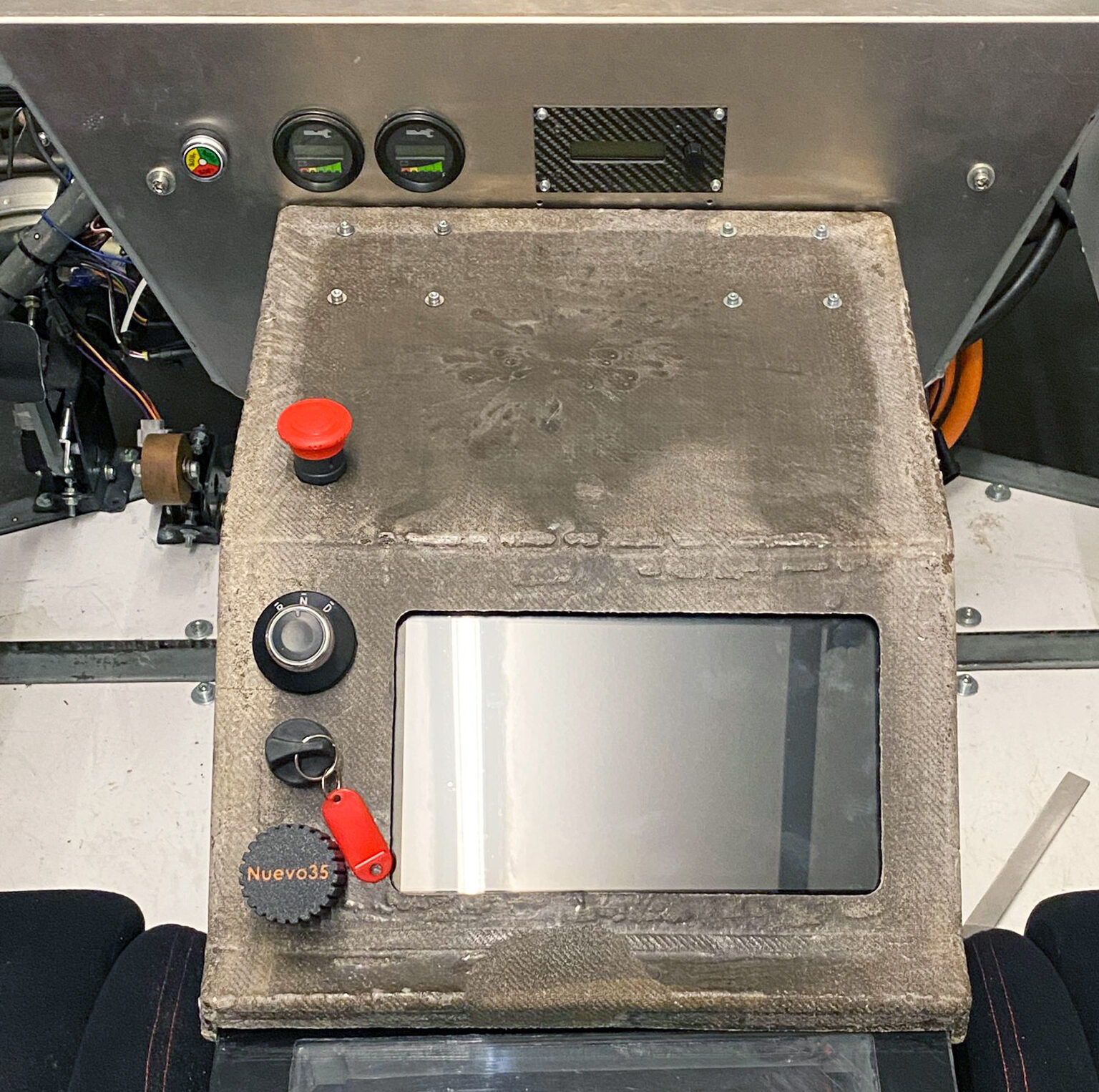
Sustainable: natural fiber center console
The team is also focusing on sustainability in the interior and has developed a center console made of natural fibers and epoxy resin - more environmentally friendly and easier to recycle than conventional variants.
The students have also already researched the best surface treatment for this innovation and milled precise cut-outs for the display and switches.
By using natural fibers, the team is also opening up a new field of research at Fachhochschule Dortmund.
A project with a future
The "Nuevo35" project shows how application-oriented research and teaching are intertwined at Fachhochschule Dortmund. The students gain practical experience in mechanics, electronics, software development and sustainability and at the same time make a contribution to the climate-friendly mobility of tomorrow.
At the same time, interdisciplinary synergies are used when, for example, students from the Faculty of Design design possible car bodies for the prototype.
Contributors
The "Nuevo35" project is led by Prof. Dr. Stefan Hesterberg, Prof. Dr. Markus Thoben and Prof. Dr. Vinod Rajamani.
The following students are currently involved:
- Project management: Joel Isaak.
- Powertrain team (including One Pedal Drive): Yassine Chebihi, Mohammed Guerami, Assia Izri, Julian Paelz, Berkem Yenigün, Abdu Dagdela, Maroune Laaouichi, Ulkay Gökdemir.
- Team Vehicle Electronics (including Dual Drive): Assem Ryan, Jakob Bothen, Moritz Bitschinski, Amir Zali, Yannick Schulte, Jessica Pilch.
- Team CO₂ footprint (including center console): Lukas Grünewald, Daniel Morcinek, Christopher Berg, Marvin Köster, Sönke Bengtsson.