

The universities in North Rhine-Westphalia are now making successful climate protection measurable. 14 universities and 16 universities of applied sciences have presented a joint balance sheet for their CO2 emissions for the first time.
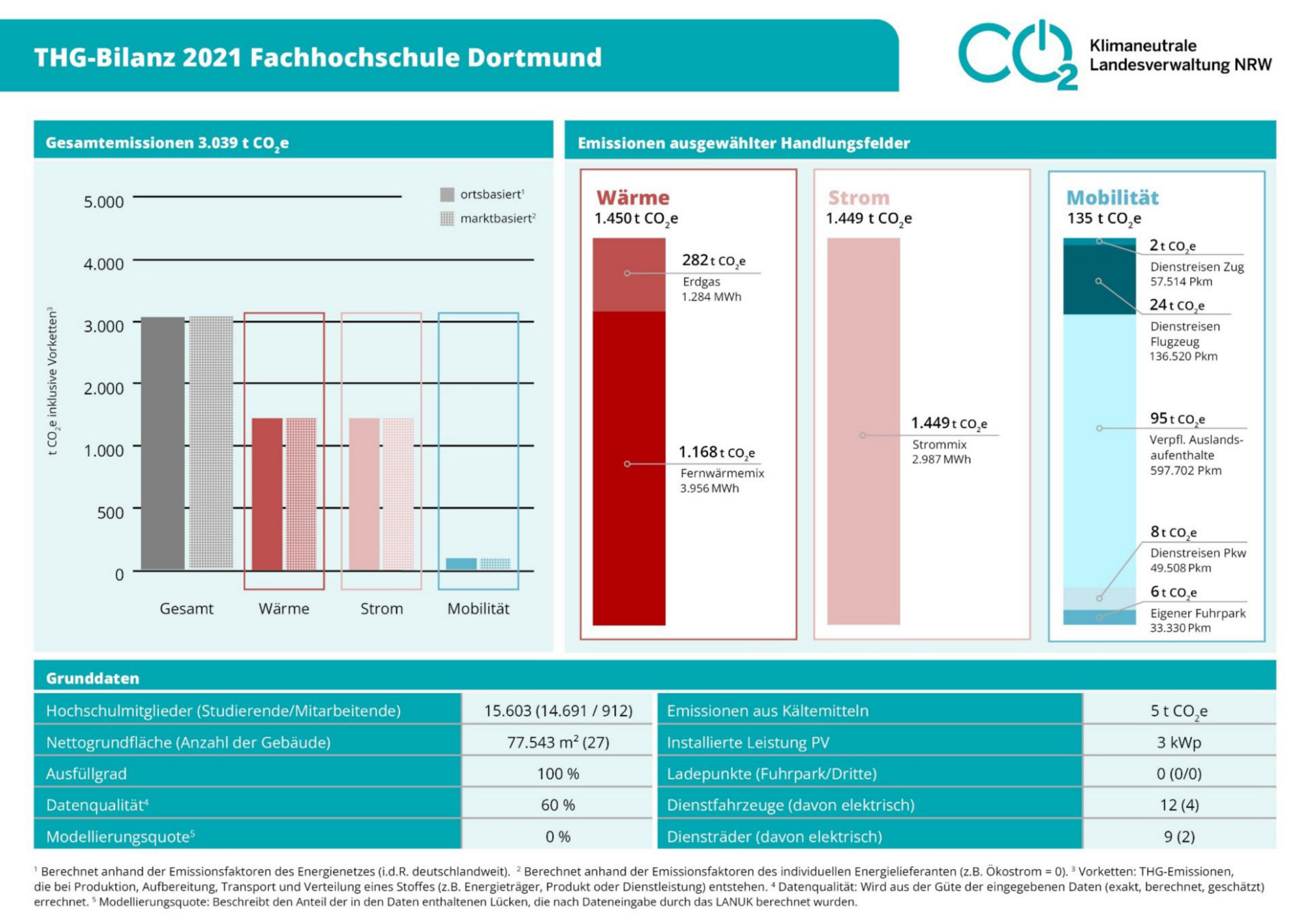
In total, the 30 public universities in NRW emitted around 441,000 tons of CO2 equivalents in 2021 - about as much as a city with 40,000 inhabitants. For Fachhochschule Dortmund, the balance sheet shows 3,034 tons of CO2 equivalents. Almost half of this is generated by heating requirements (1,450 tons) and half by electricity (1,449 tons). At 135 tons, official mobility accounts for the significantly smaller emissions pillar.
The joint greenhouse gas balance sheet (GHG balance sheet)(Opens in a new tab) based on uniform standards is the result of an initiative by the state government. The first assessment covers the years 2019 to 2021 and annual monitoring is planned for the future. The balances for 2022 and 2023 are already in progress.
"The overall balance sheet now presented by the Ministry of Business Studies and Climate Protection shows that we are on the right track in Dortmund. We can be proud of this," says Dorothee Albrecht, Climate Protection Manager at Fachhochschule Dortmund. "One of the main achievements of the assessment is that we have found a common and uniform database," adds her colleague Karen Müller.
Methodology and differences to the climate protection concept
Accounting is carried out in accordance with the requirements of the internationally recognized Greenhouse Gas Protocol standard. Greenhouse gas emissions are divided into three categories, known as scopes.
- Scope 1 are direct emissions caused by combustion or volatile gases within the university - for example from its own vehicle fleet, the consumption of natural gas or volatile gases in laboratories.
- Scope 2 are indirect emissions caused by the purchase of electricity, heating and cooling.
- Scope 3 are all other indirect emissions along the value chain, such as business travel.
While Scope 1 and 2 are fully taken into account in the greenhouse gas balance, there is considerable leeway in Scope 3, as climate protection manager Dorothee Albrecht describes. For the joint assessment, the universities have decided to initially only take into account business trips and the so-called upstream chains of purchased energy. This includes, for example, the emissions caused by mining coal or transporting crude oil.
"In our own greenhouse gas balance, which we prepared long before the joint balance for our integrated climate protection concept (IKSK), we included more areas from Scope 3," says Dorothee Albrecht. These included waste, water and procurement, but above all the commutes of students and employees.
The latter in particular explains why the figures now available differ so greatly from the ICSK's own accounting. "The journey to and from the university alone accounts for around 10,000 tons of CO2 equivalents," explains Karen Müller. Accordingly, the bottom line in the ICSK balance sheet was around 13,000 tons of CO2 equivalents for Fachhochschule Dortmund, while the new balance sheet only shows around 3,000 tons. "Although we have less data in this balance sheet, the quality of the data is significantly higher," emphasizes Dorothee Albrecht. For her, it is particularly important that "the standardized balance sheet creates the necessary clarity to manage climate protection not just as lip service, but as a measurable process."
Fachhochschule Dortmund on the right track
Fachhochschule Dortmund has long since set out to reduce its emissions. Numerous measures have already been taken to this end in recent years:
- Take electricity, for example: at just under 1,500 tons of CO2 equivalents, this accounted for almost half of the emissions recorded in the report at Fachhochschule Dortmund in 2021. "We switched to green electricity at all three main locations in 2022," says Dorothee Albrecht. At the same time, investments were made in photovoltaic systems and the output was increased from 3 kilowatt peak (2021) to 60 kilowatt peak. "We consume almost 100% of this electricity ourselves and the construction of another system is already being planned," adds Karen Müller.
- Take heating, for example: energy managers and climate protection management are working together with faculties on a number of technical adjustments to reduce heating requirements. These include controlling the heat supply and ventilation in lecture theatres and optimizing thermal bridges at entrances, for example.
- Take mobility, for example: air travel in particular is responsible for emissions. This is why, since 2022, there has been a virtual ban on flying to destinations that can be reached by train within five hours. Fachhochschule Dortmund's vehicle fleet is also being systematically converted to e-cars, company bikes and e-bikes are available for use and the university is specifically incentivizing sustainable commuting with new theft-protected bike parking facilities and bike checks.