

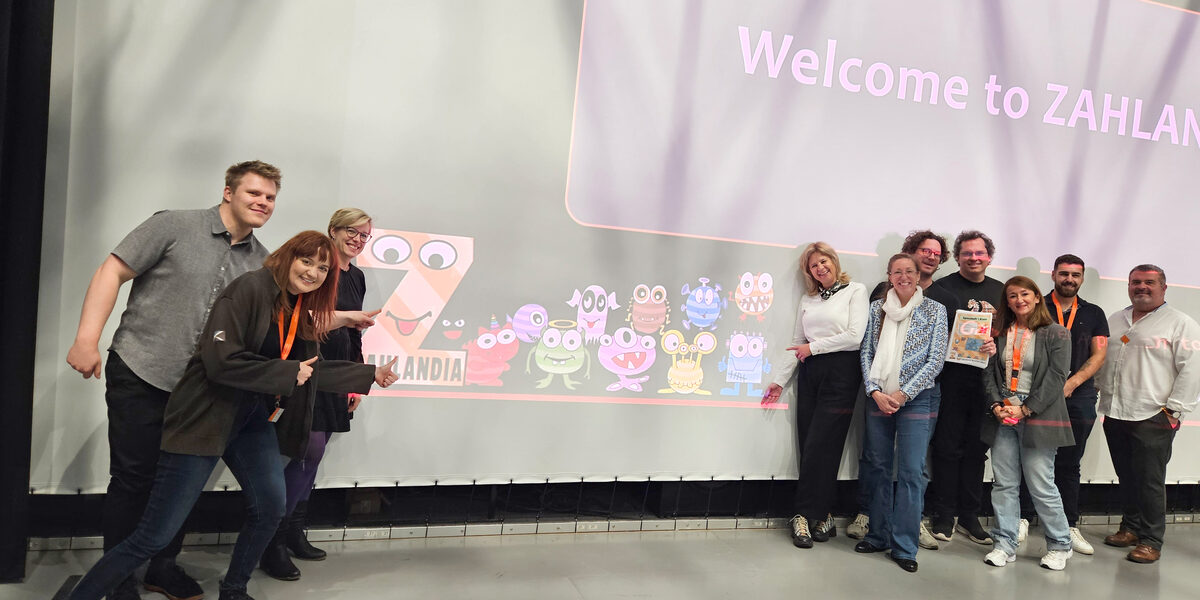
Learning math through play: a research team led by Prof. Dr. Jennifer Tiede is now turning a really good idea from a teacher into a game for primary school children.
"Math? Whew!" You hear that a lot, don't you? For many, math is simply not fun. Not yet. But maybe soon. The starting point is the analog learning game world "Zahlandia" by primary school teacher and learning therapist Timo Storz from Baden-Württemberg. In it, children meet friendly little monsters who experience adventures on ten number-shaped islands in which they can help them.
A good idea goes digital
"These adventures," says Prof. Dr. Jennifer Tiede, "are now being continued in the digital world." The game scientist and media educator teaches and researches in the fields of game studies, game-based learning and media education. She and her team have raised 250,000 euros in Erasmus+ funding for the Zahlandia research project and are leading the ten-strong team of game designers and game developers, teachers and educational game experts.
When it is finished, the digital Zahlandia game will be available free of charge and can be played on all commercially available cell phones and tablets, with translations into the languages of the developers involved: English, Spanish, Croatian, Bulgarian and German and possibly others.
A real game
Zahlandia differs from previous learning apps such as the popular German app "Anton" in one important respect: while these often offer gamified learning, i.e. rewarding the solution of school-related tasks with stars and digital items to personalize the avatar, for example, Zahlandia turns mathematics itself into a game. For example, the children roll two ten-sided dice and have to add up the points to find the next station.
Zahlandia will not replace a teacher, emphasizes Prof. Tiede. Nor is that its purpose, rather the game is "a platform for safe experimentation and playful practice. Children should ideally try it out before they develop a negative relationship with math." So that they don't see math as a problem, but as what this science can also be: a motivating challenge.
Project and people
The Zahlandia research project will run until February 2028. Prof. Dr. Jennifer Tiede teaches in the "Serious Games and Digital Knowledge" study program at the Faculty of Design at Fachhochschule Dortmund.
Involved are:
Game Design and Development:
- Rasmus Pechuel and Timo Storz, Ingenious Knowledge (Germany)
- Paulo Santos, Atlantic Infinity (Portugal)
- Tim Kreuzberg and Simona Gheoca, ArtQuest Studios ltd (Bulgaria)
Teachers and school partners:
- María Jesús López Fernandez and José Manuel Rodríguez Fernández, CEIP Tomás Romojaro (Spain)
- Sanja Dam and Nikolina Reder, Osnovna škola Trnsko (Croatia)
Project coordination and scientific support:
- Prof. Dr. Jennifer Tiede, Fachhochschule Dortmund