

Die Fachhochschule Dortmund has issued a positive interim report on its climate protection efforts. The updated joint greenhouse gas inventory for 2022 and 2023—which is compiled in collaboration with universities in North Rhine-Westphalia according to a uniform standard—shows a significant decline in emissions. Compared to the baseline year of 2019, Fachhochschule Dortmund was able to reduce its emissions by about 20 percent.
A look at the latest figures confirms the ongoing positive trend: While the university generated approximately 3,445 metric tons of CO2 equivalents in 2019, this figure dropped to 3,230 metric tons (-6.2 percent) in 2022 and fell even further to 2,753 metric tons (-20.1 percent) in 2023. This reduction was made possible by a combination of targeted building renovations, changes to operational processes, and the consistent implementation of sustainability guidelines in the university’s day-to-day operations.
Take electricity, for example: Since 2022, the Fachhochschule Dortmund has consistently purchased green electricity. As a result, emissions have been reduced to near zero on a market-based basis. “In our overall assessment, however, we continue to use the emission factor of the general German electricity mix as a basis to avoid any appearance of greenwashing,” explains Dorothee Albrecht from the Climate Protection Management department at Fachhochschule Dortmund. Yet even on this basis, efforts such as the annual energy-saving campaign are having a sustainable impact. The university’s electricity consumption has decreased; in 2023, it stood at approximately 2,900 megawatt-hours—about 16 percent lower than in 2019.
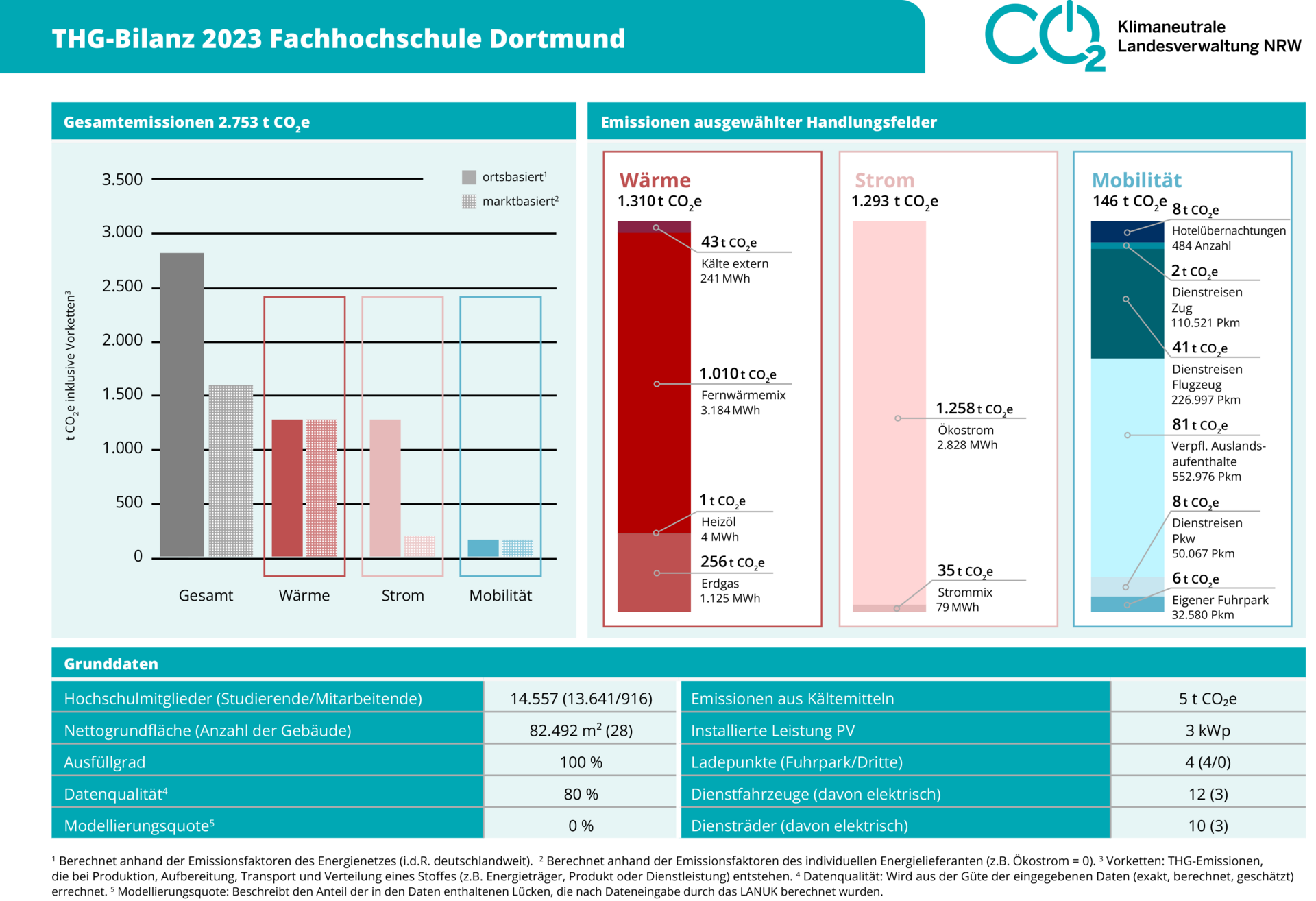
At the same time, heat consumption also decreased, in part due to technical optimizations. For example, at the Max-Ophüls-Platz (MOP) location, all heating pumps were replaced in 2021 with new, controlled models that are connected to the building management system. At the Otto-Hahn-Straße location, smart solutions proved effective. By fall 2022, the Institute for the Digital Transformation of Application and Living Domains (IDiAL) had been fully equipped with smart radiator thermostats. As a result, heat consumption there was reduced by nearly 40 percent.
In the area of mobility, the greenhouse gas footprint scorecards show the largest percentage change. CO2 emissions fell by 63 percent between 2019 and 2023. “We have to take into account that the number of business trips will still not have returned to pre-COVID levels by 2023,” admits Karen Müller from Climate Protection Management. For 2024, the climate protection managers are anticipating an increase in business travel again. Nevertheless, emissions can continue to decline. “The fact that, according to a decision by the Rector’s Office, domestic flights within Germany are permitted only in absolutely exceptional cases is having a lasting effect,” says Karen Müller. This now also applies to European destinations that can be reached by train within five hours.
With the mobility survey currently underway, Climate Protection Management is also focusing on the commuting habits of students and employees. “Even though these emissions won’t be included in the official greenhouse gas inventory until 2027, we want to use the survey results to develop additional options for sustainable commuting right now,” says Dorothee Albrecht.
The standardized greenhouse gas inventory for North Rhine-Westphalia’s universities is part of the “climate-neutral state administration” goal. Through this initiative, North Rhine-Westphalia is working toward climate neutrality by 2030 for 531 government agencies and institutions. “Uniform and transparent reporting provides us with the necessary foundation to manage climate protection at our university not as mere lip service, but as a measurable, strategic process,” emphasizes Karen Müller. The reports for the years 2019 through 2021 were published in the spring of 2026. The university’s climate protection management team is currently working on the report for the year 2024.