
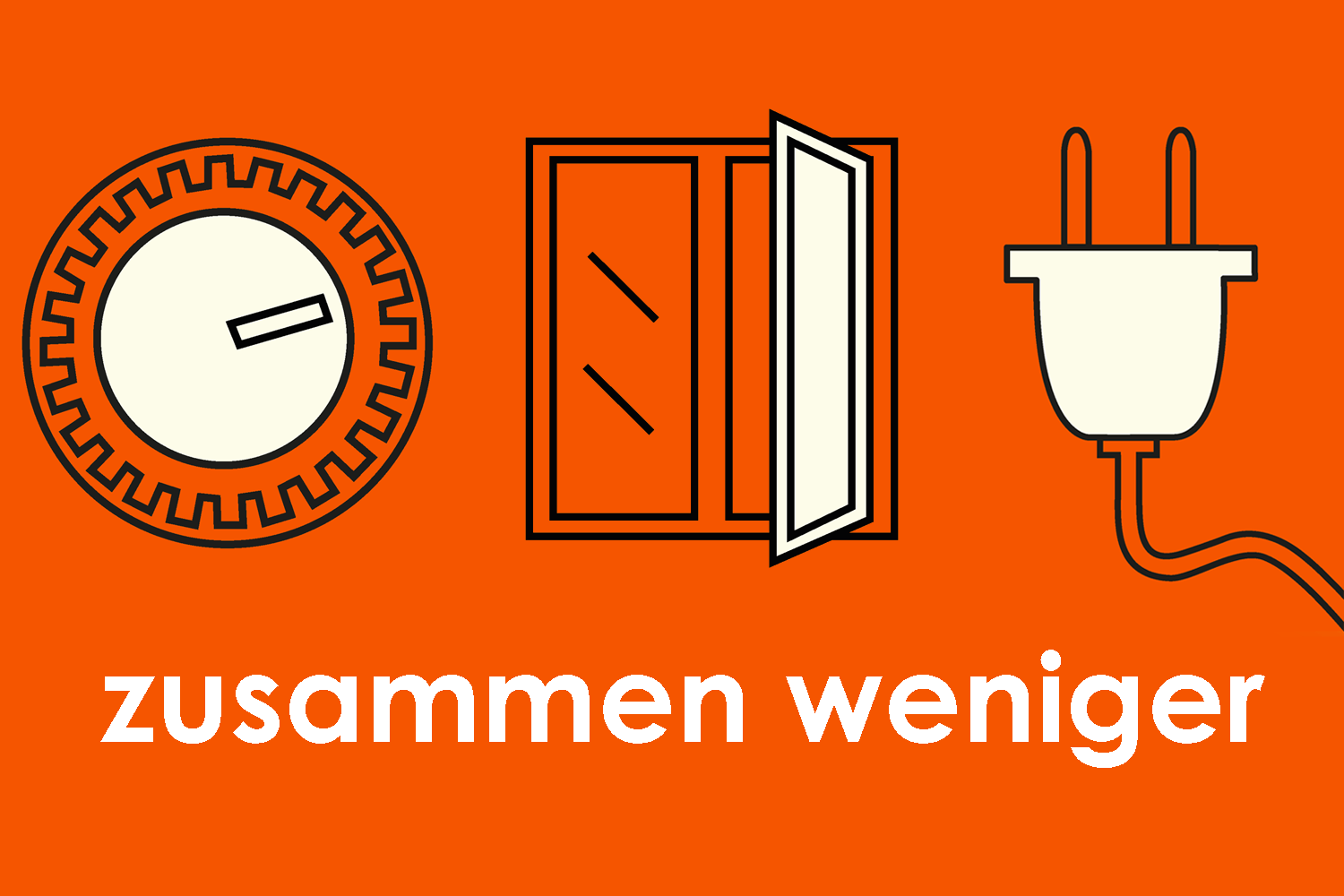
The "Together Less" campaign is based on three areas of action:
1. Energy Efficiency
2. Renewable Energy
3. Energy Conservation Campaign
As a university of applied sciences, however, our mission is not only to conserve energy, but also to fulfill our social responsibility as an employer and partner—and, in particular, as an educational institution for more than 12,000 students.
You can contact us at any time at energiesparenfh-dortmundde
Period of the campaign
Service stands
During the campaign, there will be service stands at the university locations where we would like to have a direct exchange with you. What can you expect there?
- Reminder stickers on the topics of electricity, ventilation and heating
- Energy-saving checklists for offices, seminar rooms, laboratories and tea kitchens
- Remaining stocks of adapter plugs and room thermometers
- Information on other ways to save energy
Please take the opportunity to report any defects, such as leaking windows or broken thermostats.
The stands will be set up in the foyer on the Sonnenstraße campus and in the Kostbar on Emil-Figge-Straße. An information stand will be set up at Joseph-von-Fraunhofer-Str. and Max-Ophüls-Platz throughout the entire period.
Dates of the service stands
At the heart of the campaign are the following energy use behaviors:
All students and employees can make a valuable contribution through their own behavior. Every kilowatt hour saved counts.
Lights off
- Turn off the lights when you leave the room.
- Turning off the lights when you leave the room can save up to 4% energy.
Switch off appliances
- Switch off appliances when you no longer need them.
- Switching off devices such as computers, monitors, printers and scanners can save up to 14% energy.
To get an overview of how much energy electrical devices consume, power measuring devices can be borrowed from the library's device lending(Opens in a new tab) service.
Turn the heating off or down
- If possible, radiators should not be more than 20°C. This corresponds to level 3 on the thermostat.
- There should be no furniture in front of the radiators.
- Turning the heating down by 1°C saves 6% of the heating energy.
Ventilate in bursts instead of tilt ventilation
- Ventilate 3 to 4 times a day for 3 - 5 minutes during the winter months.
- Switch off the heating during ventilation.
- Shock ventilation instead of tilt ventilation saves up to 7% energy.
Stairs instead of the elevator
- Use the stairs instead of the elevator, this saves electricity and keeps you fit.
New Campaign Elements
1. Digital Clean Up
Data transmission, server capacity, cloud storage, and modern AI applications require a constant supply of energy. Since our digital footprint usually remains invisible, awareness of it is often still low. With the Digital Clean Up, we’re shedding light on our everyday digital consumption. Even small daily habits can make a big difference—not only for climate protection but also for your own IT security and keeping track of your data.
- Free up storage space & reduce CO₂ emissions: Regularly deleting old emails, duplicate files, and unused cloud data reduces the load on server infrastructure and lowers energy consumption.
- Use AI & media mindfully: Artificial intelligence, high-resolution streaming, and large amounts of data consume a lot of energy. Use digital tools purposefully and efficiently.
- Strengthen digital sovereignty and IT security: A tidy environment is also a more secure one. Structured data management protects sensitive information and enhances digital sovereignty.
The specific offerings for the campaign period are currently still being developed.
2. Building Inspections: Working Together to Unlock Potential at Our Locations
In late February/early March 2027, we will visit the various buildings at the Fachhochschule Dortmund. Through direct dialogue with users from the faculties and the administration, we aim to discuss specific challenges, identify quick wins, and find tailored solutions.
Content & Topics of the Site Visits:
| Quick Wins in Behavior | Quick wins in technology & infrastructure |
| Proper heating & ventilation: Maintain optimal room temperatures and ventilate by opening windows fully rather than leaving them ajar. | Reporting issues & defects: Immediately address and correct rooms that are too cold or too warm, as well as defective or malfunctioning thermostats. |
| Avoiding Standby Power Loss: Turn off devices and use switchable power strips after work. | Optimize building systems: Check for airtight windows, ensure proper use of ventilation systems, and utilize modern LED lighting. |
| Lighting & Room Usage: Make smart use of natural light, turn off lights when leaving, and use rooms as needed. | Special Areas & Motion Detectors: Assess laboratories, workshops, and traffic routes on a case-by-case basis (e.g., determine where motion detectors are appropriate). |
Energy-saving tips for the home and office
Read how you can make a contribution with small changes in the office and at home. Saving resources starts with the most everyday things. With the right know-how, effective savings can be achieved here.